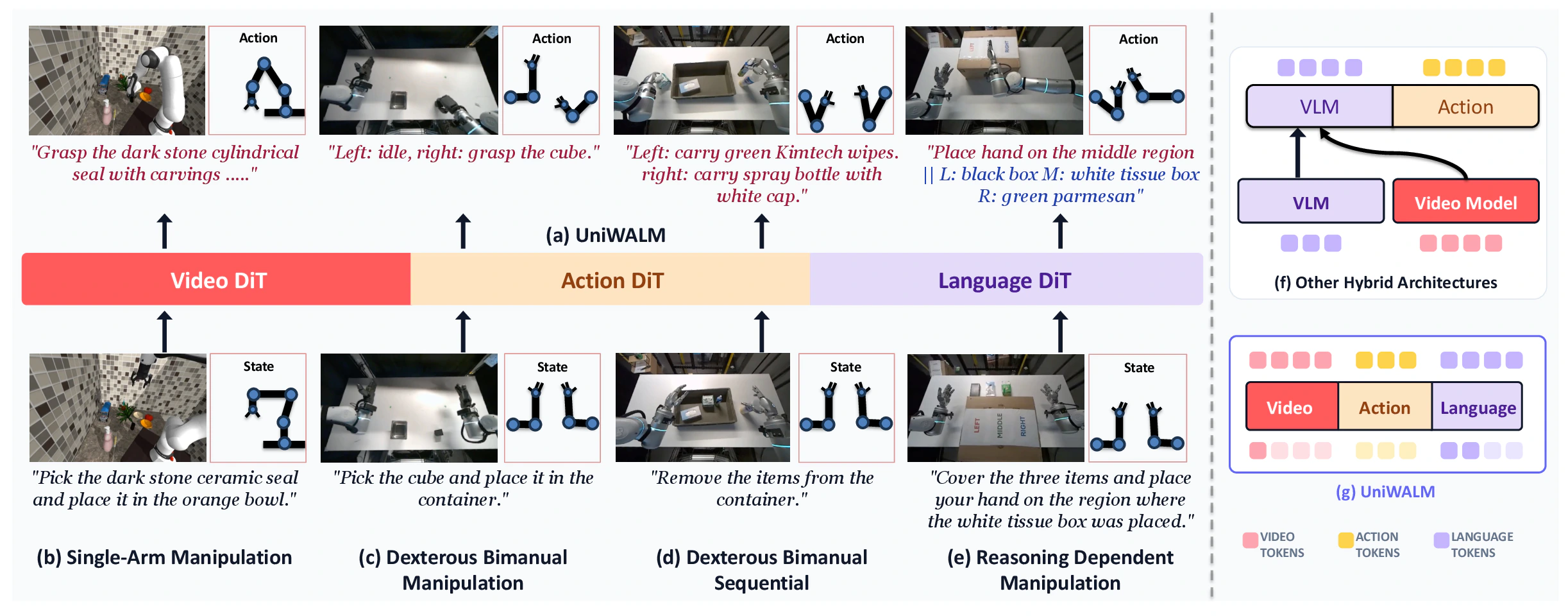
We built UniWALM to study whether learning to describe a task helps a robot carry it out. The model starts from a pretrained video backbone. During training, three transformer streams share information as they predict future frames, robot movements, and text. At each control step the robot can generate an action together with a short description of its progress, then read that description at the next step.
We also trained the action stream to correct errors by perturbing trajectories and teaching the model how to return to the intended path. The correction happens during training, so the deployed policy uses the same number of sampling steps.
On four simulated RMBench tasks that require remembering earlier observations, UniWALM completed 34.5% of trials. FastWAM, a video-and-action model built on the same backbone, completed 13.3%.
Finding a hidden item
We placed a black box, a packet of Parmesan, and a tissue box side by side. The robot could see all three before it covered them with cardboard. To point to a particular item afterward, it had to remember where it had seen it.
In one trial, as the robot grasped the cardboard, UniWALM generated a note placing the black box on the left, the Parmesan in the middle, and the tissues on the right. We could read the note the model passed to its next control step and watch where its hand went once the items were out of sight. On the physical robot, UniWALM found the requested item in 61.1% of trials. FastWAM succeeded in 11.1%. Choosing among the three positions at random would succeed about a third of the time.