Avoiding Object Damage in Robotic Manipulation
We built and deployed a damage-risk classifier that reduced robot-induced object damage in a warehouse manipulation system.
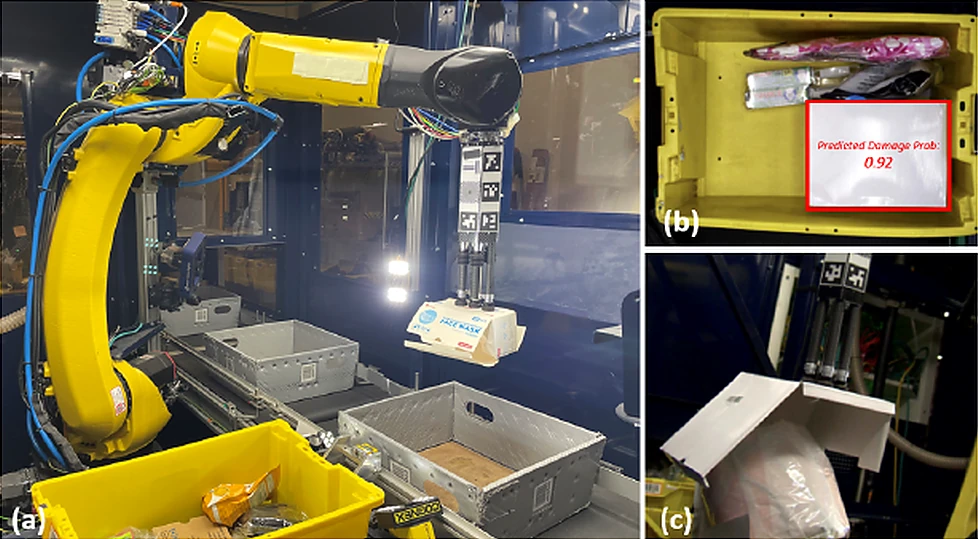
Reliable warehouse robots need to do more than complete picks: they must also avoid damaging the enormous variety of objects they encounter. Damage is rare relative to the number of successful manipulations, but each event can destroy inventory, interrupt a workcell, or harm sensitive equipment.
In this IROS 2024 paper, we introduced a system that predicts the risk of object damage before a robot attempts a pick. The prediction combines information from warehouse catalog systems with attributes observed at the workcell and outcomes from earlier manipulations.
Modeling damage risk
We first developed a taxonomy for damage caused by robotic handling, including crushing, tearing, opening, and objects separating into multiple parts. We then compared several ways to predict those outcomes:
- Classical models including logistic regression, random forests, XGBoost, and CatBoost
- A BERT classifier that can use unstructured product descriptions
- A multimodal ViT-BERT model that combines text and images of the picking scene
The multimodal model performed best in the offline study, showing that product descriptions and visual context contain complementary information. For deployment, we used the BERT model because it offered a strong balance between predictive performance and integration complexity.
Deployment result
We evaluated the system over 50,687 real pick-and-place operations using control and treatment groups. When damage avoidance was enabled, the robot skipped picks predicted to be unsafe. This reduced the object-damage rate by 64%, with a 9% reduction in picking volume.
That tradeoff is central to deploying safety models: a system needs to prevent costly failures without rejecting so many actions that throughput collapses. The study demonstrates how operational data and multimodal learning can turn an infrequent failure mode into a prediction problem that can be managed before a robot acts.
This work was led by Erica Aduh and Fan Wang, with Dylan Randle, Kaiwen Wang, Priyesh Shah, Chaitanya Mitash, and Manikantan Nambi.
Read the Amazon Science publication page or the full paper.